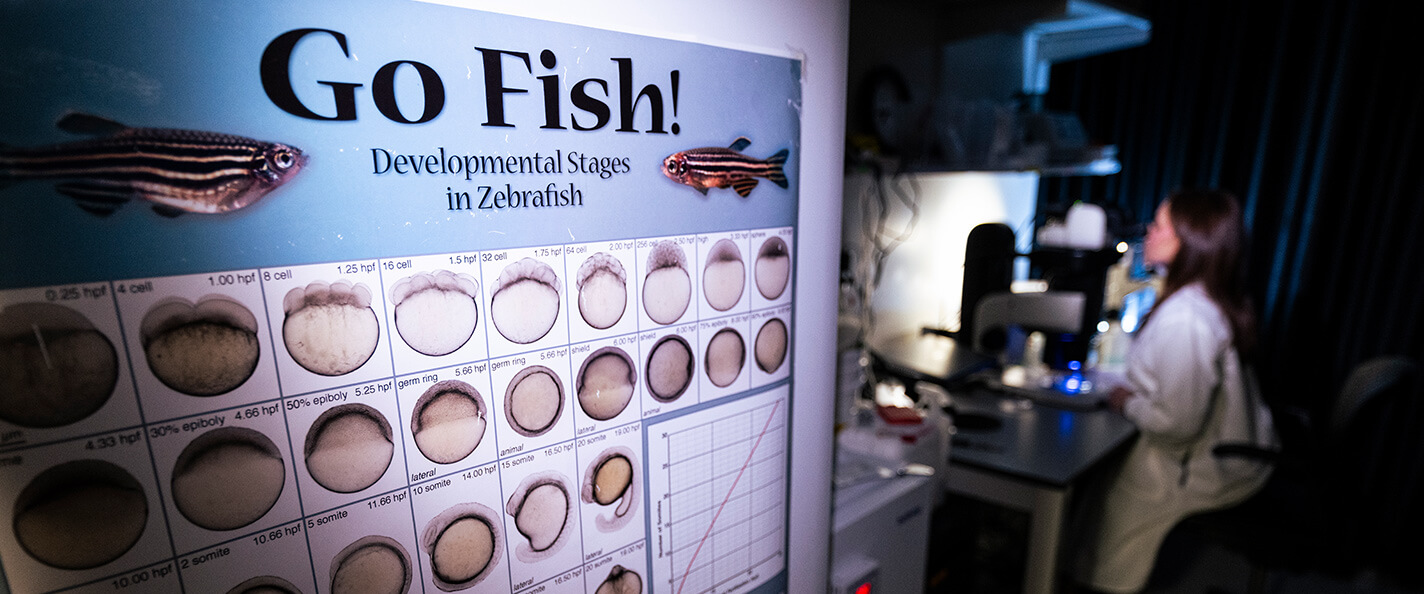
Of all the world’s problems, perhaps the most heartbreaking is childhood cancer. It attacks the vulnerable and cuts lives tragically short. Alice Alhaj Kadour ’23, PhDx’27 is part of a UW effort to find a cure for diffuse intrinsic pontine glioma (DIPG), one of the most aggressive forms of childhood cancer — one that attacks the brain and is uniformly fatal. As part of UW–Madison’s Tamplin Lab, Alhaj Kadour is looking for creative ways to better understand how DIPG develops, pointing the way, ultimately, toward a cure.
What got you interested in cancer research?
One of my grandfathers had horrible lung cancer when I was 7, and he passed away from that. Ever since then I was very intrigued by medicine and cancer biology. I initially started my undergraduate degree on a premed route, and I worked as a certified nursing assistant. Throughout my time taking care of patients, there were many times when all we could do was focus on making people comfortable. That experience was what initially drew me toward research. There is still so much we don’t understand about human disease, and I wanted to be part of the work happening behind the scenes to find answers and hopefully develop new ways to help people.
Why study DIPG?
It is very devastating how this cancer only hits children, and it has very devastating outcomes. The kids usually only survive eight to 11 months. … There has been an incredible amount of research dedicated to understanding this disease, and while researchers have made important strides, translating that knowledge into meaningful improvement remains a significant challenge in the field. As I started learning more, I became really fascinated with the biological mechanisms and how much we could learn from this new model that we were developing.
You’re trying to use zebra fish to develop a model that will help you see how DIPG develops. Why is that work important?
One of the main gaps in the field that this project aims to address is understanding tumor initiation in the context of the developing brain. A lot of the past and current research in the field focuses on studying and understanding the established tumor biology, which is incredibly important and has contributed to the progress that has been made in understanding the disease and improving patient survival. Because these tumors are so aggressive and often difficult to treat by the time that they’re diagnosed, we wanted to develop a model that would allow us to look at an earlier point in the disease process. We’re interested in understanding how these tumors first develop and whether there’s anything we can learn about their earlier biology that we wouldn’t be able to see by studying established tumors. We hope to contribute another piece to our understanding of this disease that could help inform future research.
Read more about Alhaj Kadour and the UW’s work with DIPG in On Wisconsin magazine.